
Quick answer
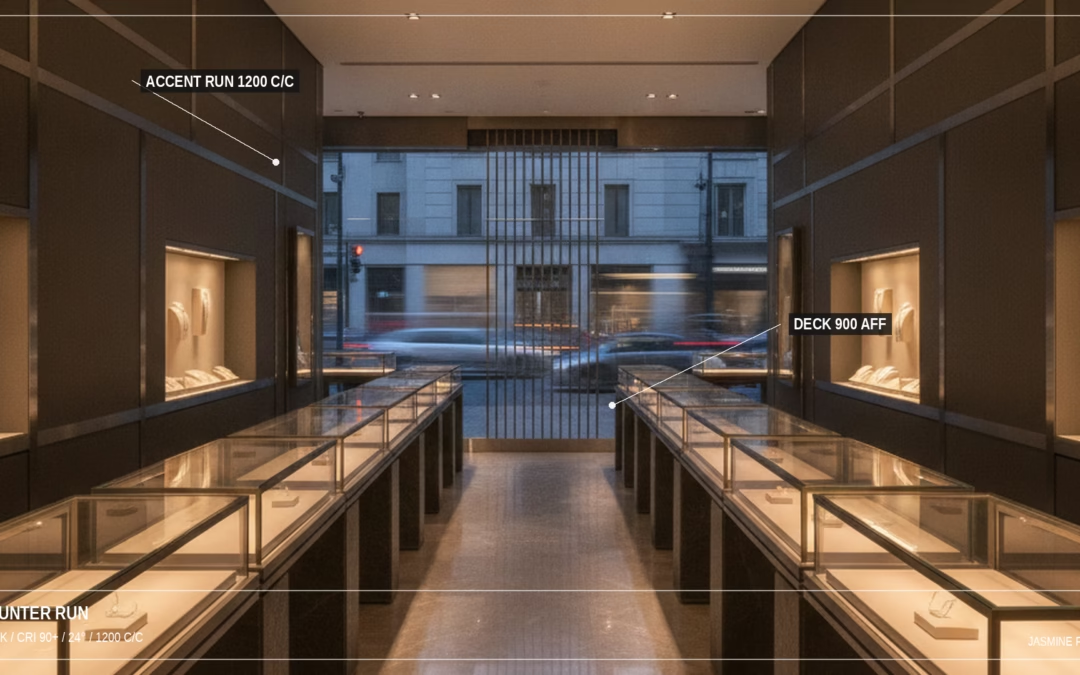
Specify jewelry display case lighting at 3000K with CRI 90+ (Ra and R9 both), a 10-24 degree beam for accent spots and a diffused strip for fill, and keep the source out of the customer’s sightline with a 30-45 degree shield or recessed baffle. Aim for roughly 1,000-3,000 lux at the display deck depending on stone and metal, keep UV below the level that fades packaging and velvet, and always mock up one counter before ordering the rest.
Two boutiques can hold identical stock under identical rent and sell at very different rates, purely because one counter lets a customer see the stone and the other reflects the ceiling back at them. Lighting is the cheapest variable in that equation and the one most often left to whoever supplies the LED strip.
This is the specification logic we use when a display counter goes from concept drawing to shop drawing: what to fix, what to leave adjustable, and which numbers actually change how the product reads on the deck.
Start with what the counter has to prove
Before choosing a fitting, decide what the counter has to demonstrate. A diamond counter has to prove colour and cut; a gold counter has to prove warmth and finish consistency; a watch counter has to prove legibility of dial and case detail. Each demands a different combination of beam angle and colour rendering. Diamond and white-metal counters read best under a slightly cooler white with high colour rendering, because a warm cast makes near-colourless stones look yellow. Yellow gold and rose gold read better a step warmer, otherwise the metal looks flat and the finish looks thin. A watch counter sits between the two: the dial has to stay legible and the case brushing has to show direction. That decision has to be made before the ceiling void is closed. Retrofitting a lighting intention after the plasterboard goes up is how counters end up with surface-mounted track over a millimetre-perfect stone plinth.
Colour rendering: CRI 90+ is the floor, not the target
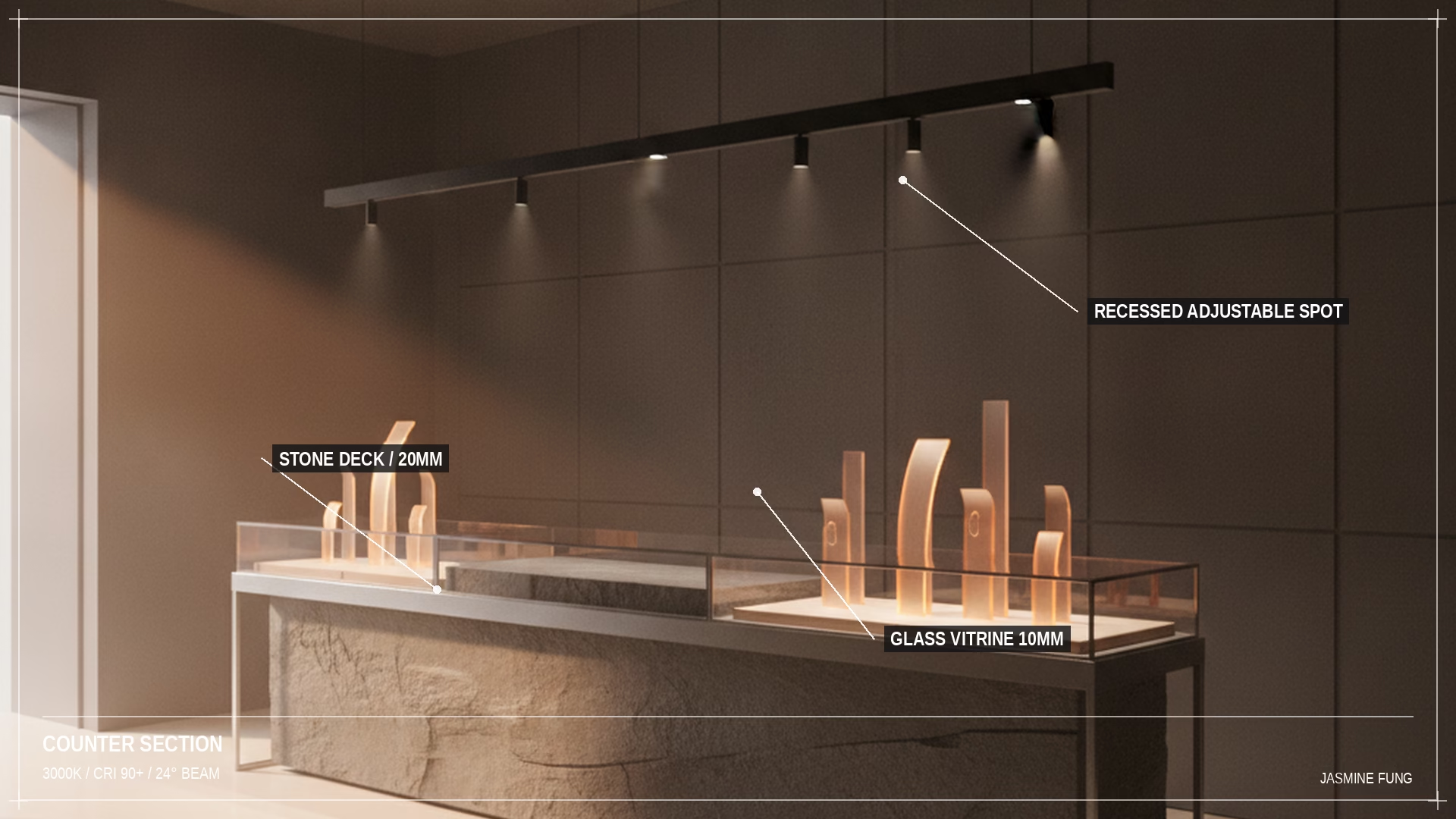
Colour rendering is usually quoted as a single Ra figure, which is not enough for jewellery. Ra averages eight pastel test colours and says nothing about how a deep red ruby or a saturated blue sapphire will read. Ask for R9 as well, and treat anything below R9 50 as unsuitable for coloured stones. For most counters the practical minimum is CRI 90+ with R9 in the 60-90 range, at 3000K for gold and mixed metal, 3500-4000K for diamond-led counters where a whiter reading is wanted. Consistency matters more than the exact figure: if one fitting in a run of six is a different bin, the counter will show a visible patch, and customers read patches as damage.
| Counter type | Colour temp | CRI / R9 | Accent beam | Deck level (approx.) |
|---|---|---|---|---|
| Diamond and white metal | 3500-4000K | 90+ / R9 60+ | 10-15° | 2,000-3,000 lux |
| Yellow and rose gold | 3000K | 90+ / R9 70+ | 15-24° | 1,000-2,000 lux |
| Coloured stones | 3000-3500K | 90+ / R9 90+ | 10-15° | 2,000-3,000 lux |
| Watches | 3000-3500K | 90+ / R9 50+ | 24-36° | 1,000-1,500 lux |
Beam angle is geometry, not a preference
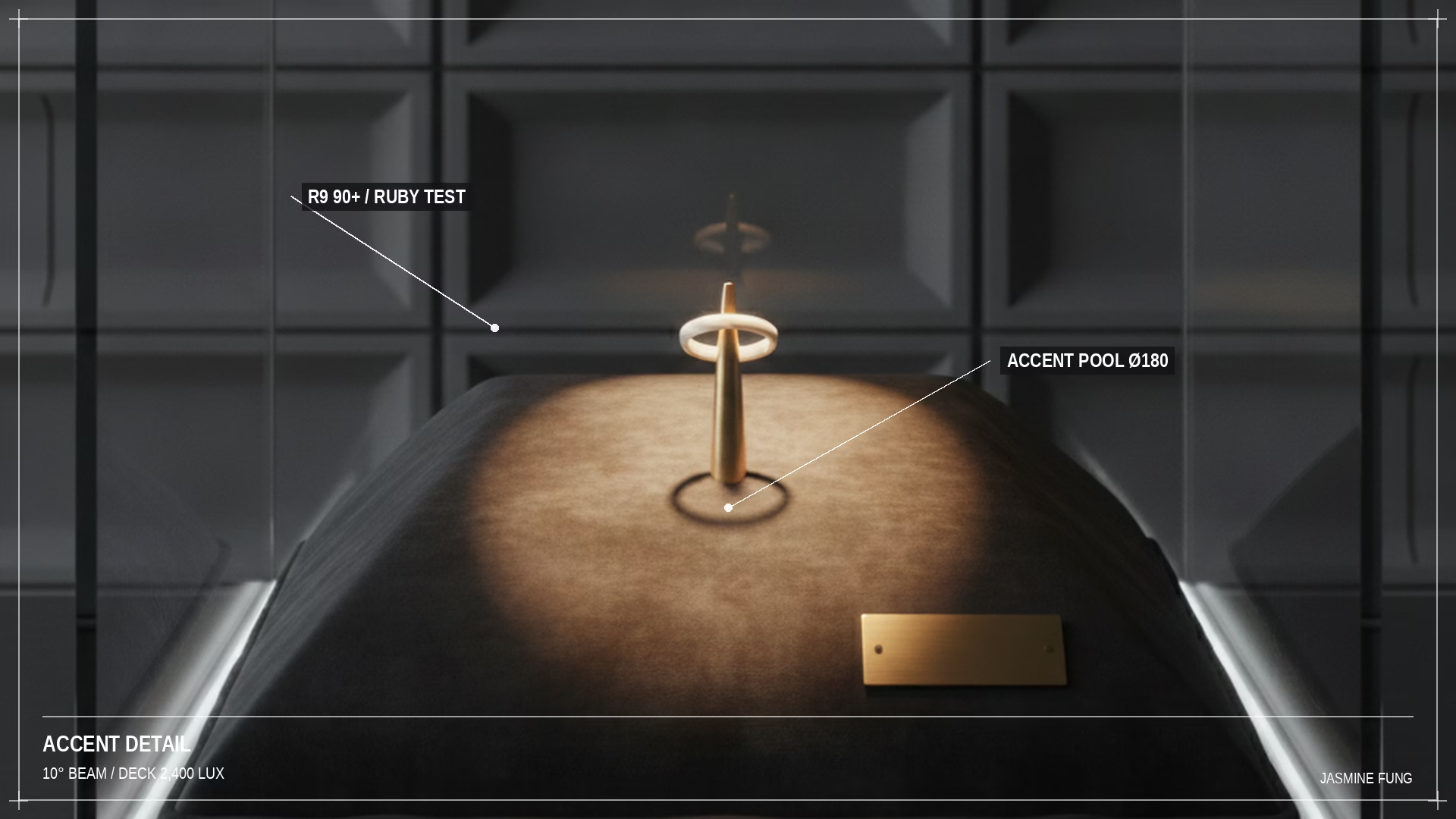
A 10-15 degree beam puts a tight pool of light on a single piece; a 36 degree beam washes a whole tray. The right choice depends on the distance from fitting to deck and the spacing between pieces, not on taste. The workable rule is to set the beam so the pool is roughly 1.5 to 2 times the width of the item being lit. Two adjacent rings lit by overlapping 10 degree pools will read as one bright smear; the same pieces under 24 degree beams at correct spacing read as separate objects with their own shadow. Where the deck is deep, put the accent on the front edge of the piece rather than its centre, so the light travels across the surface instead of flattening it. Adjustability is worth paying for. A fixed spot in a millimetre-accurate counter is a decision you cannot revise when the collection changes in six months; a 30 degree tilt and 355 degree rotation lets the same counter serve three seasons.
Glare and reflection: what customers actually complain about
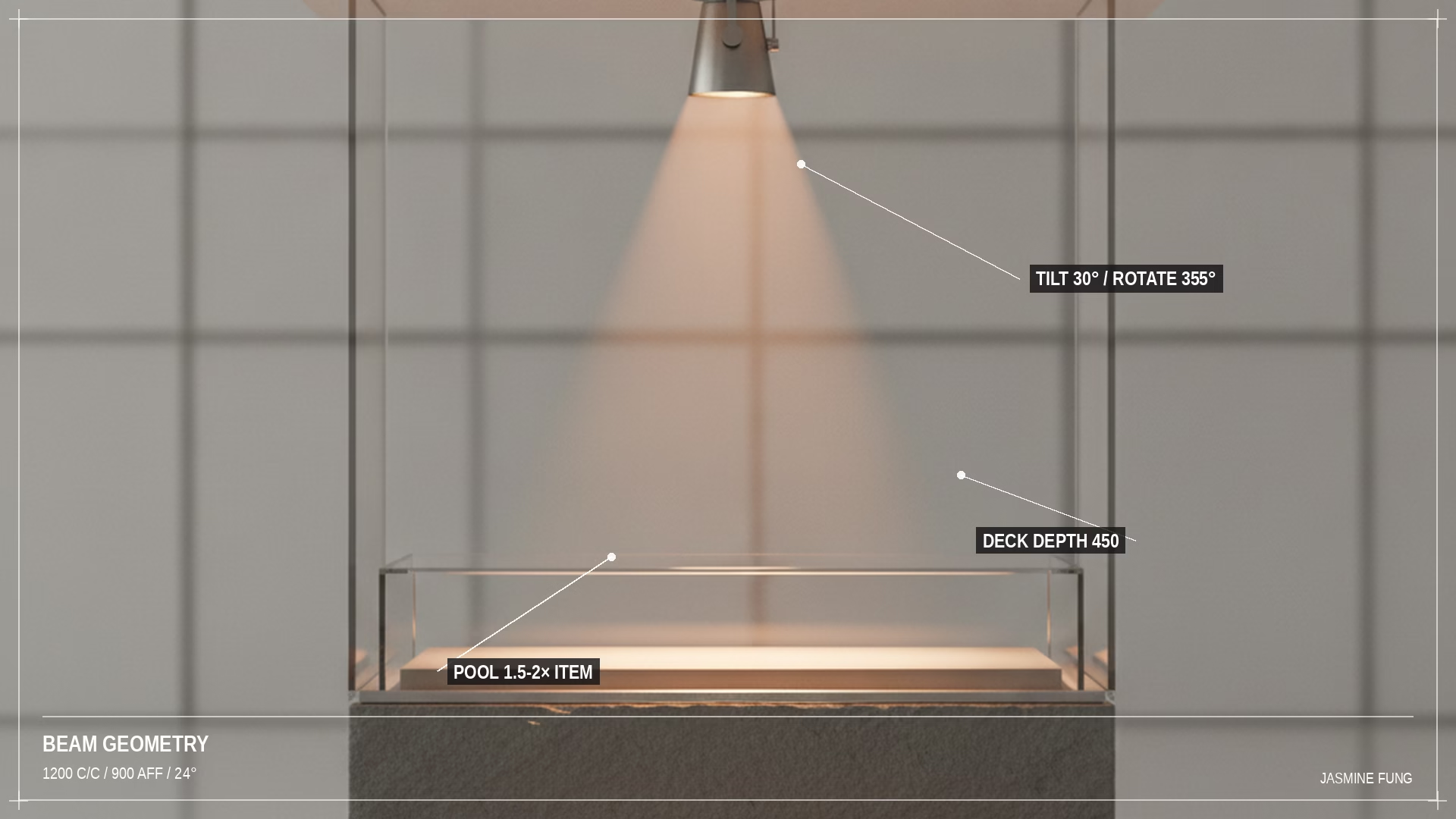
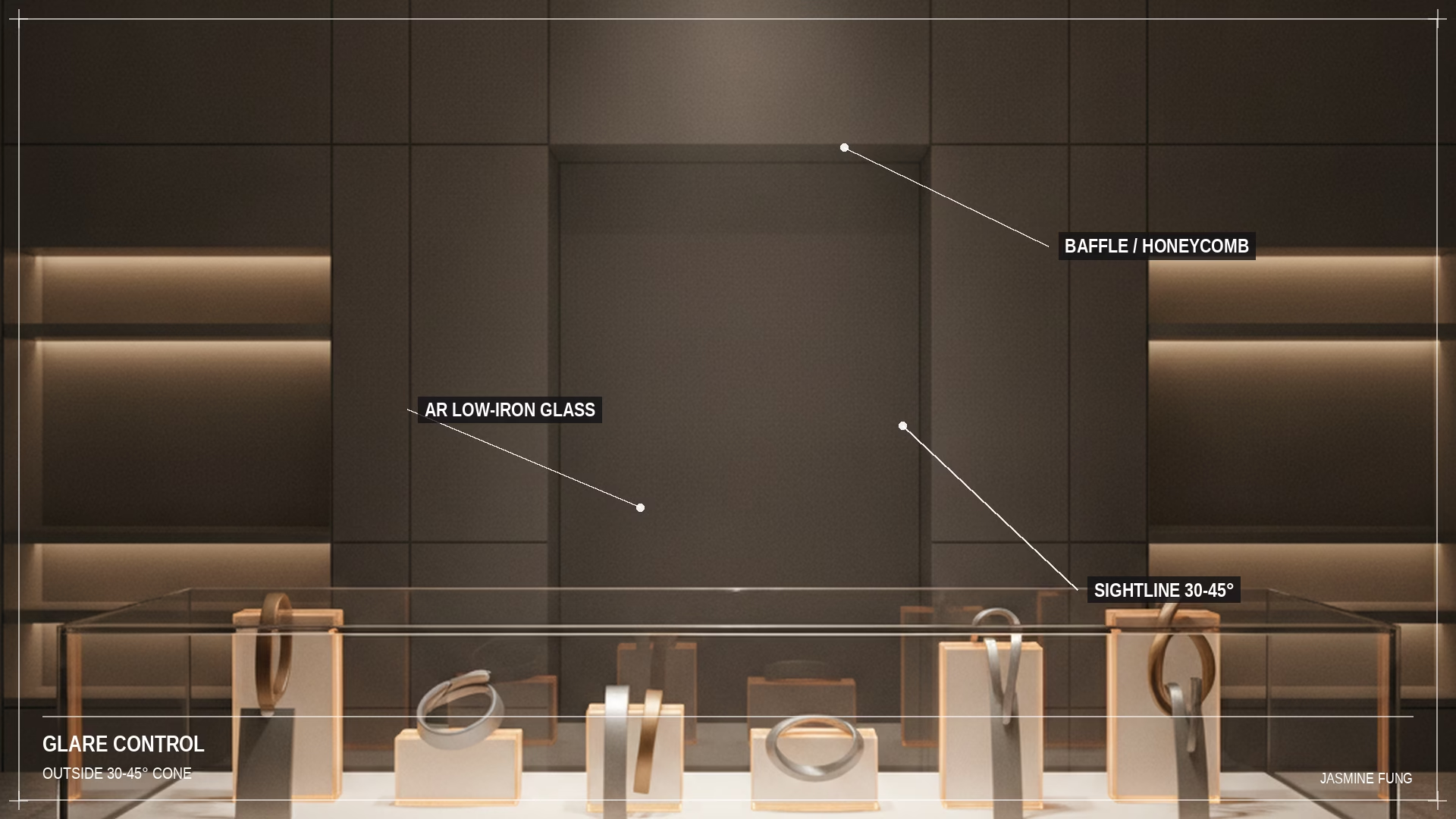
The most common counter complaint is not dim light, it is a bright line across the glass at eye height. The fix is mechanical rather than electrical: recess the fitting, add a baffle or honeycomb louvre, and set the fitting outside the 30-45 degree cone that a standing customer looks through. Low-iron glass with an anti-reflective coating reduces the second problem, the reflection of the customer’s own face over the tray. It costs more per square metre than standard float glass but changes the shopping experience more than an extra 500 lux ever will. Angle the deck lighting from the viewer’s side rather than straight down. A light placed slightly forward of the piece and aimed back at it produces a shadow behind the object, which gives it presence; light from directly above removes the shadow and, with it, the depth that makes a stone look like a stone.
Heat, UV and the ten-year counter
Jewellery counters are lit for eight to twelve hours a day for years, so thermal design matters as much as colour. Keep drivers out of the display volume and in an accessible service position, because a driver that fails behind a sealed plinth takes the counter out of service with it. UV is the slower problem. It fades velvet, discolours acrylic trays and degrades packaging. Specify UV-filtered output or a glass interlayer that blocks it, particularly where the counter faces a shopfront and takes daylight on top of the artificial light. Commission the counter under real stock. A lighting scheme that looks correct on an empty deck often fails once black velvet, printed collateral and brand props are in place, because every one of those surfaces changes the reflected light. Snag it in the evening, with the shopfront dark, and again at midday, because the two conditions are effectively two different lighting designs.
Key takeaways
- Fix the target first: diamond, gold, coloured stone and watch counters each need a different colour temperature and beam.
- Quote R9 with the CRI: Ra 90 alone does not tell you how a ruby or sapphire will render.
- Beam angle follows geometry: pool width should be about 1.5-2 times the item, which usually means 10-24 degrees.
- Glare is a mechanical fix: recess, baffle, and keep the source outside the 30-45 degree sightline.
- Commission under real stock, twice a day, before you order the second counter.
Further reading
- jewelry counter displays that carry brand impact
- luxury gold jewelry store concepts
- store design that sells
- commercial design projects
What CRI do I need for jewelry display case lighting?
CRI 90+ at minimum, and ask for the R9 value as well. Ra averages eight pastel colours and hides red rendering, which is exactly what a ruby or a warm gold finish depends on. R9 60+ is workable for mixed metal, R9 90 for coloured stones.
Is 3000K or 4000K better for a jewelry counter?
3000K for gold and rose gold, 3500-4000K for diamond and white metal counters where a whiter reading is wanted. Whichever you choose, keep every fitting in the run from the same bin so the counter does not show visible patches.
How many lux should a display counter have?
Roughly 1,000-2,000 lux at the deck for gold and watches, 2,000-3,000 lux for diamond and coloured stone accents. The number matters less than the ratio between accent and ambient, which is what creates contrast on the piece.
Why does the glass reflect the customer’s face?
Because the light source or the shopfront is inside the reflection angle. Recessing and baffling the fitting, plus low-iron glass with an anti-reflective coating, removes most of it. Tilting the accent slightly forward also helps.
Should display lighting be adjustable?
Yes. A 30 degree tilt and full rotation lets one counter serve different collections across seasons, and lets you correct a pool that lands badly once stock is in place. Fixed spots lock in a decision you cannot revise.