
Quick answer
A modular window display system lets a two-person crew re-dress a 6 sq m retail window in about 90 minutes, against 6-9 hours for a built-in set. The system is a 40 mm aluminium profile grid plus four to six reusable modules – plinths, risers, backdrop cassettes and a dimmable light track – built for a 3-5 year life and budgeted at HK$18,000-HK$45,000 per window in Hong Kong.
Most retail windows in Hong Kong are still built as one-off joinery sets. They look right on opening night and become a liability by the third campaign, when the props no longer fit the new product, the plinth heights are wrong, and the only way to change the scene is to cut and rebuild it. The re-dress then runs into two overnight shifts, and the window sits half-finished through the first weekend of the campaign.
A modular window display system solves that by separating the parts that stay from the parts that change. The grid, the plinths, the backdrop cassette and the light track are permanent, specified once and reused for three to five years. Only the props, graphics and product arrangement change each season. This article sets out the components, the re-dressing time you should budget, the lighting specification that survives constant re-rigging, and the cost bands we use when planning a window in Hong Kong.
What is a modular window display system?
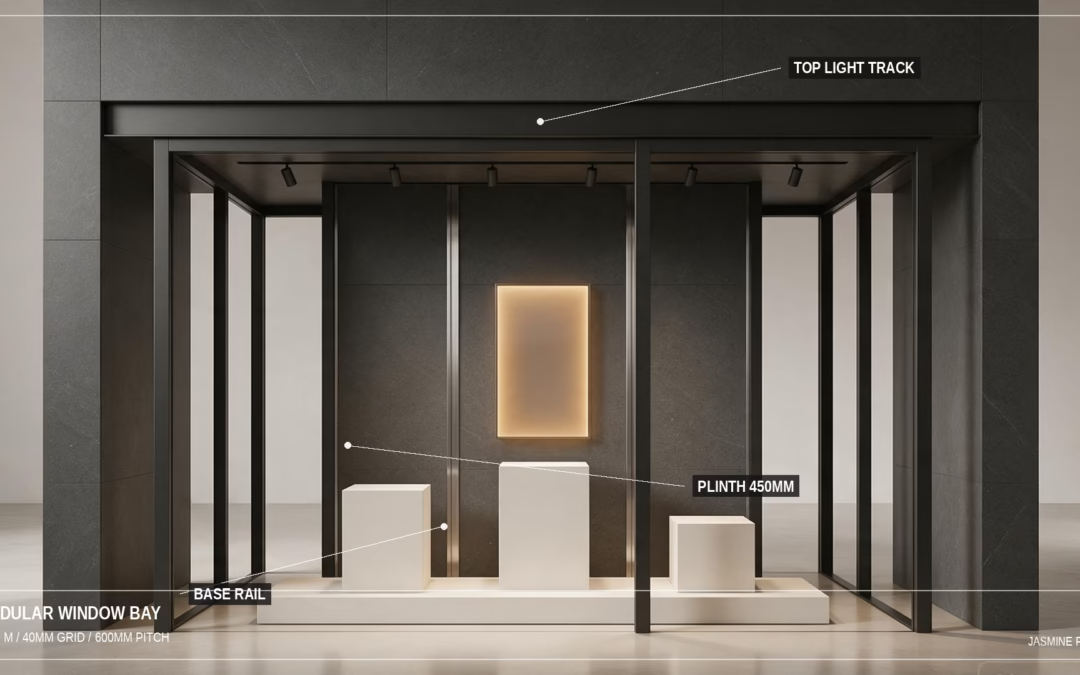
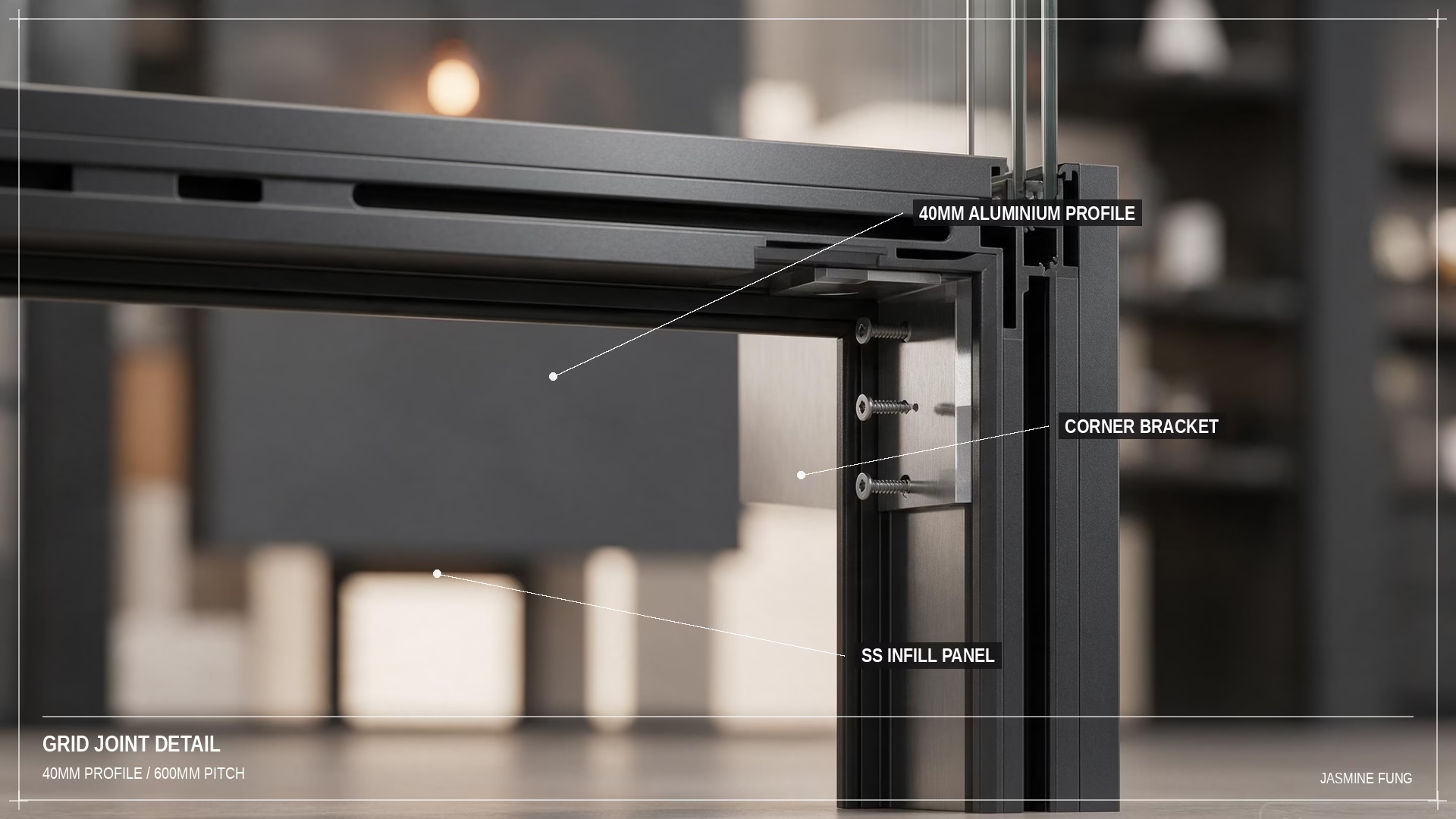
A modular window display system is a fixed structural grid inside the window, with a standard set of interchangeable components that hang, sit or clip onto it. The grid is normally 40 mm aluminium profile, powder-coated matte black or bone white, set 150 mm back from the glass so the frame itself is never the first thing a passer-by sees.
The grid carries three things: vertical standards at 600 mm centres for shelves and graphic panels, a base rail for plinths, and a top rail for the light track. Because the pitch is fixed, every module is designed once and reused – a plinth ordered for a jewellery campaign in March is the same plinth used for a fragrance launch in September.
Unlike a built-in set, nothing is glued or screwed into the shopfront. That matters in Hong Kong, where most mall windows are leased shells with restrictions on fixing into the floor and ceiling. A freestanding grid braced to the base rail avoids both, and comes out at the end of the tenancy without making good.
How long does it take to re-dress a window?
The number that decides whether a modular system pays for itself is re-dressing time, not capital cost. A built-in joinery set typically takes 6-9 hours to strip and rebuild with a crew of three or four, which in a mall means two overnight shifts once you allow for protection, cleaning and the glass being re-polished at the end.
A modular kit with loose props takes 90-150 minutes with two people. The grid stays. Plinths are unbolted from the base rail and re-set at the new heights, the backdrop cassette slides out and is replaced, props are re-arranged, and the light scene is recalled from the controller.
Where the kit includes a light box graphic cassette rather than printed panels, the change drops to 45-75 minutes, because nothing is re-taped or re-aimed. The table below is the range we plan against for a 6 sq m window.
| Window format | First build | Seasonal re-dress | Crew | Storage per window |
|---|---|---|---|---|
| Built-in joinery set | 3-4 weeks off-site + 5 days on site | 6-9 hours | 3-4 | 2.5 sq m |
| Modular grid + loose props | 4-6 days on site | 90-150 minutes | 2 | 0.6 sq m |
| Modular grid + light box cassettes | 5-7 days on site | 45-75 minutes | 2 | 0.9 sq m |
| Digital panel on fixed plinth | 2-3 days on site | 20-30 minutes, content only | 1 | 0.3 sq m |
Which modules do you actually need?
Most windows need six modules and no more. Adding a seventh usually adds cost without adding selling power.
The base set is a 40 mm profile grid at 600 mm pitch; three to five plinths at 300, 450 and 600 mm heights, which covers product from a ring pad to a handbag; one backdrop cassette in the window’s full width; one dimmable light track on the top rail; and a set of risers in 50 mm increments for levelling product to the eyeline.
The sixth module is the one most projects forget: a graphic cassette that holds a printed or backlit panel behind the product. In a jewellery window it is usually a 900-1,200 mm wide panel at knee-to-chest height, because that is where a shopper’s sightline lands from the mall corridor. Without it, every campaign ends with a hand-cut foam board taped to the glass, which is the most common reason a well-designed window photographs badly.
How do you specify lighting for a window that changes eight times a year?
Lighting is where modular windows usually fail. The track is installed once, but the product changes, and a fixed aim that flattered a gold necklace in February will flatten a matte ceramic in October.
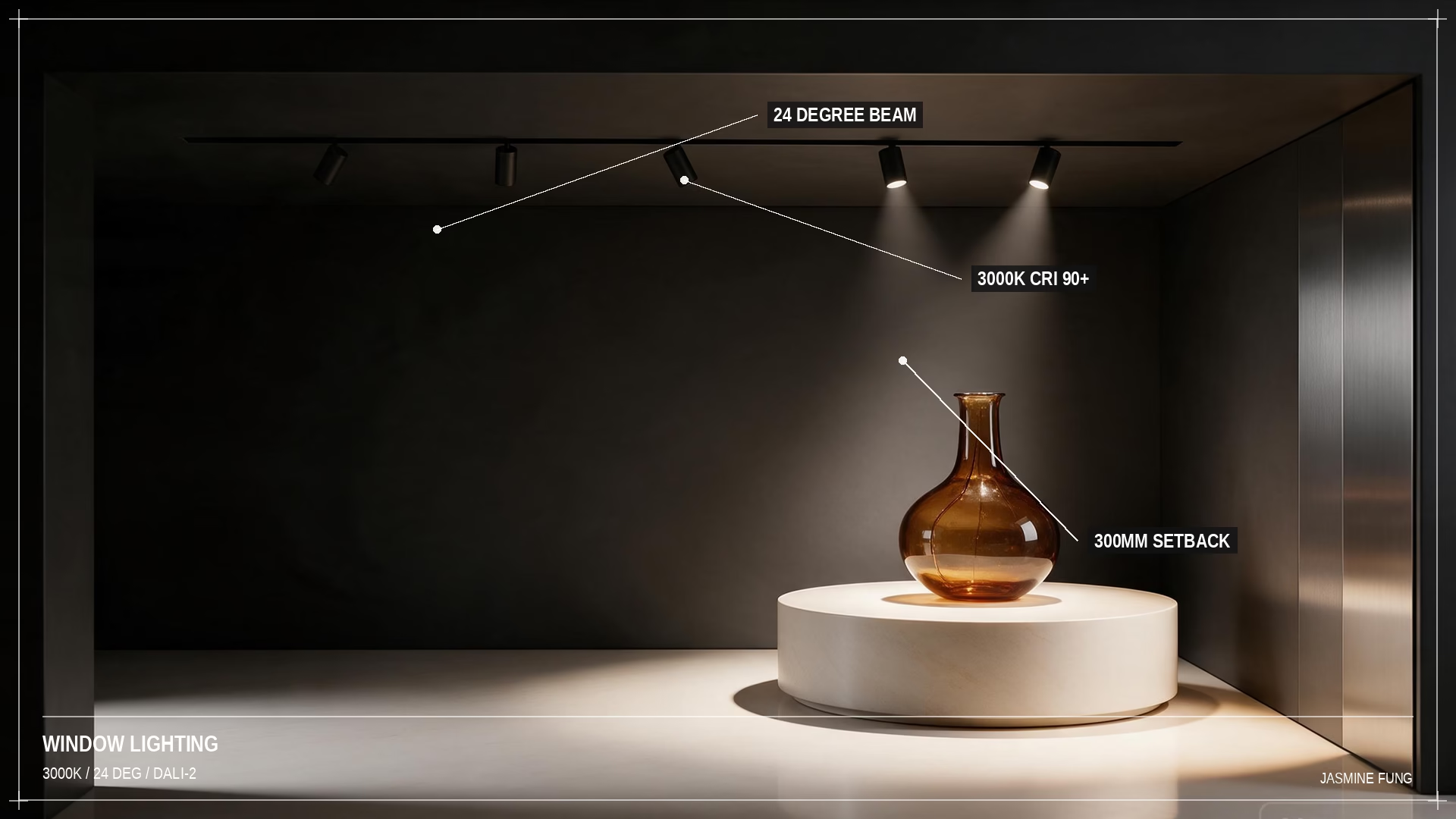
Specify 3000K, CRI 90 minimum with R9 above 50, and 15-40 degree interchangeable lenses rather than a single fixed beam. Put every head on DALI-2 or a comparable dimming protocol, and commission three scene presets at handover: day (window reading against 20,000-30,000 lux of mall ambient), dusk, and night. Changing a scene is then one button, not a ladder and a torch at 11 pm.
The numbers we aim for are 3,000-5,000 lux on the hero product, an 8:1 contrast ratio against the window background, and a 24-36 degree beam for a mannequin or a large prop, narrowing to 10-15 degrees for a single small piece. Keep the ambient window wash at 300-500 lux so the accents still read as accents.
One practical detail: mount the track at least 300 mm behind the glass. Flush-mounted fittings throw a hot spot onto the pane and, at night, turn the window into a mirror of the corridor behind the shopper.
What does a modular window display system cost in Hong Kong?
Budgets are quoted per window, not per sq ft, because the cost is driven by the number of modules and the finish level rather than the floor area. A 6 sq m window and a 9 sq m window often price within 20 per cent of each other once the kit list is the same.
The bands below are what we use for early planning. They assume a matte powder-coated finish, MDF plinths with a sprayed or laminate face, and standard electrical connection to an existing mall supply point. Stone, solid surface, brass inlay or integrated screens move the number materially, usually by 40-60 per cent.
| Scope | Budget (HK$) | Notes |
|---|---|---|
| Frame grid only, 40 mm profile | 12,000-18,000 | Reused across every season |
| Grid + 4 plinths + backdrop panel | 18,000-28,000 | The most common scope |
| Full kit with light track and cassettes | 28,000-45,000 | Dimmable track, two graphic cassettes |
| Seasonal concept design, per campaign | 8,000-15,000 | Excludes production |
| Install and re-dress labour, per visit | 3,500-6,000 | Two-person crew, night works |
How do you control glass reflection and the viewing cone?
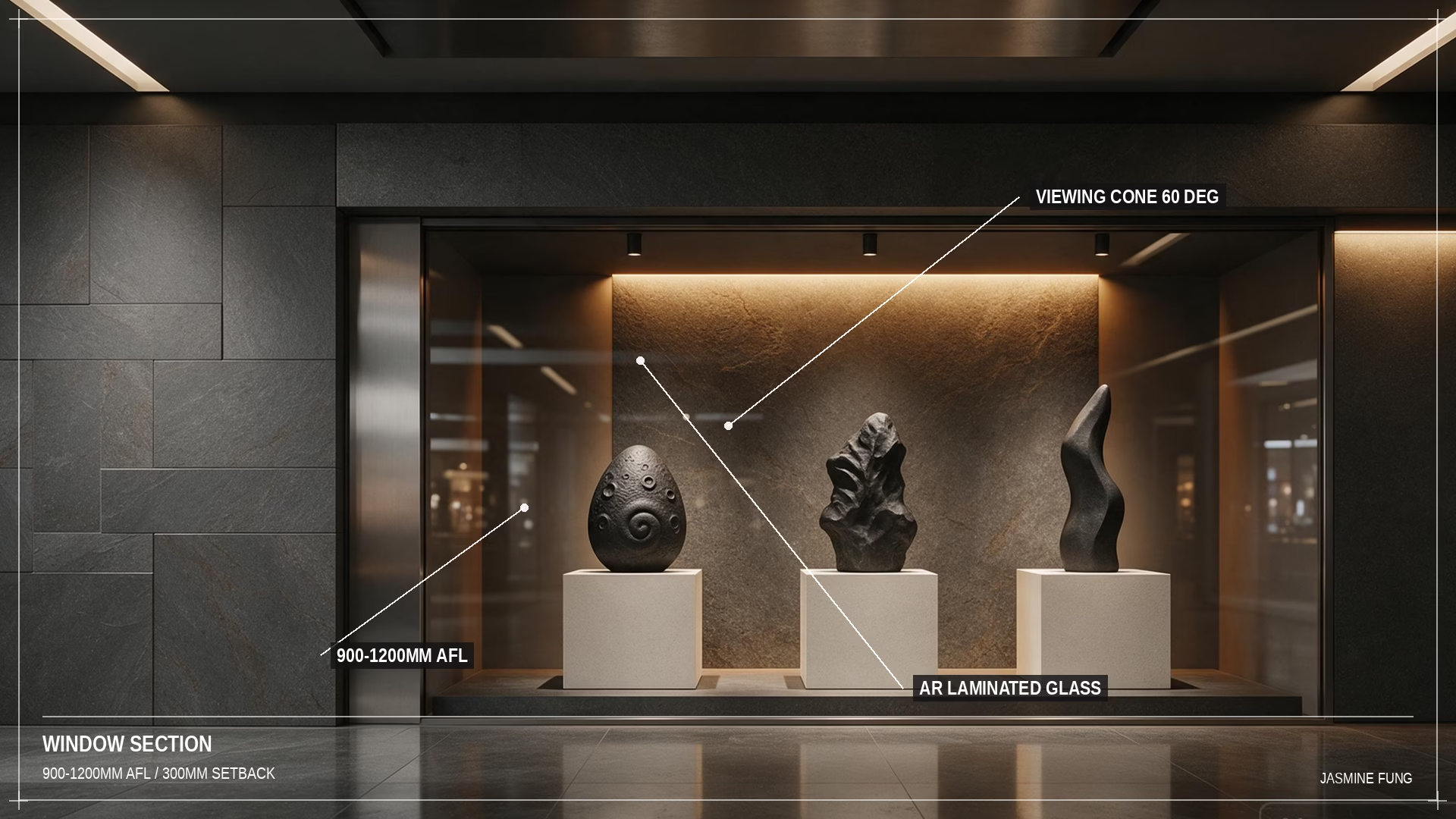
A retail window has a viewing cone of roughly 60 degrees from the centre of the glass to the mall corridor. Anything outside that cone is decoration for the staff, not for the customer. Set the hero product within 900 mm of the window centre and at 900-1,200 mm above finished floor, which is chest height for most adults and the natural reading position for a small object.
Reflection is a geometry problem before it is a coating problem. Keep the light source behind the product rather than between the product and the glass, angle heads at 20-30 degrees from vertical for windows, and leave 300-450 mm between the product and the pane. Anti-reflective glass helps, but a 2 mm AR laminated pane adds roughly HK$1,800-HK$2,600 per sq m and will not rescue a badly aimed track.
At dusk the balance shifts. Mall ambient drops faster than the window’s own lighting, so a scene tuned at 11 am looks blown out at 7 pm. Hence the three presets above, driven by an astronomical time switch rather than a fixed clock, so the change tracks sunset through the year.
How do you store and freight the kit between seasons?
A modular kit is only modular if it can be packed flat and found again. Build the packing logic into the design: every module gets a code, every crate gets a manifest taped inside the lid, and the manifest matches the drawing revision used for the campaign.
A 6 sq m window flat-packs into roughly 0.6 sq m of floor area and 1.2 m of height – two 1,200 x 800 mm crates on castors is typical. That is the difference between a tenant keeping the kit in a 2 sq m store room and paying HK$600-1,200 per month for external storage.
Hong Kong humidity is the other consideration. MDF plinths swell at the edges after two or three wet seasons if stored against an external wall, so seal the exposed edges, store on a pallet with 50 mm of air underneath, and use a moisture absorber in each crate. Aluminium profile is unaffected, though powder coat will chalk if stacked against a sun-facing wall.
On lead time, allow eight weeks from concept sign-off to installation for a first kit, and three to four weeks for each seasonal prop set thereafter. Christmas windows should be in production by the first week of October.
Key takeaways
- Re-dress time: budget 90-150 minutes with two people for a modular kit, against 6-9 hours for built-in joinery.
- Six modules: grid, plinths, backdrop cassette, light track, risers and a graphic cassette cover almost every campaign.
- Lighting: 3000K, CRI 90+, interchangeable 15-40 degree lenses, three commissioned presets on DALI-2 dimming.
- Cost: HK$18,000-HK$45,000 per window for the kit, plus HK$8,000-HK$15,000 per seasonal concept.
- Storage: about 0.6 sq m of floor area per window if the kit is designed to flat-pack from the start.
Further reading
- Jewelry display case lighting: CRI, beam angle and glare control
- Luxury retail interior design: a Hong Kong fit-out brief
- Maximizing brand impact with effective jewelry counter displays
- Designing luxury gold jewelry store concepts for high-end shopping malls
How long does it take to install a modular window display system?
The first installation takes 4-7 days on site for a 6 sq m window, including the grid, plinths, electrical connection and lighting commissioning. Each seasonal re-dress after that takes 90-150 minutes with two people, or 45-75 minutes if the kit uses light box graphic cassettes instead of printed panels.
Is a modular window display system more expensive than bespoke joinery?
The first kit costs about the same as a comparable bespoke set, roughly HK$18,000-HK$45,000 for a 6 sq m window. It becomes cheaper from the second campaign, because only props and graphics are remade – typically HK$6,000-HK$12,000 per season instead of HK$20,000 or more for a rebuilt set.
Can one modular kit be reused for different product categories?
Yes, if the plinths are specified in 150 mm height increments and the backdrop is a cassette rather than a fixed panel. A kit built for jewellery usually serves watches, fragrance and small leather goods without new structure, because the change is in plinth height, prop scale and lighting aim rather than in the grid.
What lighting should be specified for a retail window display?
3000K at CRI 90 or above with R9 above 50, interchangeable 15-40 degree lenses, and dimmable drivers on DALI-2 or an equivalent protocol. Aim for 3,000-5,000 lux on the hero product, an 8:1 contrast against the window background, and three commissioned scenes for day, dusk and night.
How much storage space does a modular window kit need?
About 0.6 sq m of floor area and 1.2 m of height per 6 sq m window, usually two 1,200 x 800 mm crates on castors. Seal MDF edges, store on pallets with 50 mm of air underneath, and add a moisture absorber per crate for Hong Kong humidity.