
Quick answer
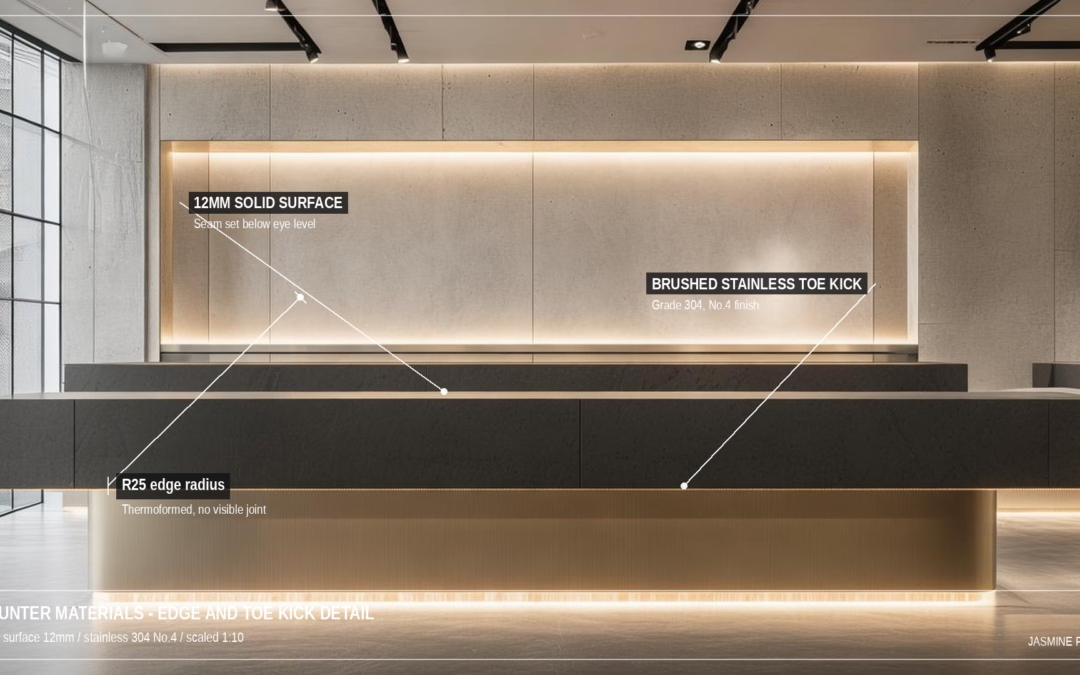
For a retail counter in Hong Kong, budget HK$900-1,600 per linear metre for a 12mm acrylic solid surface top against HK$1,400-2,400 for brushed stainless steel, and expect 3-4 weeks lead time for solid surface versus 6-8 weeks for a fully welded metal counter. Specify solid surface where the counter is curved, jointed or likely to be repaired in place; specify brushed stainless where it takes trolley impact at a loading point. Both need a sealed sample approved in writing before fabrication starts.
Counter specification is where a shop fit-out either absorbs wear quietly for a decade or shows every trolley knock within a month. Most disputes I see are not about design intent; they are about a material choice made from a photograph, signed off verbally, and discovered to be wrong only after the counter is on site.
This guide compares the three materials that dominate retail counters in Hong Kong – acrylic solid surface, cast acrylic and brushed stainless steel – on the numbers that actually decide a project: cost per linear metre, lead time, repairability, and the maintenance cycle a client will genuinely run. It is written from a fabrication and site perspective rather than a showroom one.
What is the difference between solid surface and acrylic?
Solid surface is a manufactured sheet: roughly two thirds aluminium trihydrate mineral filler bound in resin, pigmented through the full thickness, cast and then sanded. Acrylic, in the retail-counter sense, usually means a cast acrylic sheet – clear or coloured – used for display risers, illuminated panels and small plinths rather than a load-bearing worktop.
The confusion is worth clearing early because the two are priced differently and fail differently. A solid surface counter is structurally homogeneous: you can cut into it, sand it back, and join two pieces with a seam you can barely find. A cast acrylic panel is transparent, cannot carry a heavy cash drawer without a sub-frame, and scratches visibly in a way that cannot be polished out on site.
- Solid surface: opaque, repairable in place, thermoformable into curves, joints sanded flush.
- Cast acrylic: transparent or translucent, edge-lit, brittle under point load, needs a supporting frame.
- Brushed stainless: metal skin over a substrate, impact-tolerant, cannot hide dents.
- Engineered stone: hardest wearing surface, but joints are visible and cannot be refinished on site.
Cost per linear metre in Hong Kong
The table below is what a 600mm deep, 950mm high counter actually costs to fabricate and install in Hong Kong, including a substrate carcass, edge build-up and site fitting but excluding electrical work and any stone or metal feature cladding. Figures are for 2026 tender-stage budgeting and move with mill lead times, so treat them as a range to test against two quotations, not a fixed price.
Note where the money goes. A solid surface counter’s cost sits mostly in fabrication labour and the seam work; a stainless counter’s cost sits in the sheet gauge, the welding and the polishing. If a quotation for brushed stainless comes in close to solid surface, ask what gauge the sheet is – 1.2mm will oil-can across a 1.8m span.
| Material | Cost per linear metre | Lead time | Edge options | Repairable in place |
|---|---|---|---|---|
| 12mm acrylic solid surface | HK$900-1,600 | 3-4 weeks | Thermoformed, any radius | Yes, sand and buff |
| Cast acrylic panel on frame | HK$1,100-1,900 | 2-3 weeks | Polished flat only | No, replace panel |
| Brushed stainless 304, 1.5mm | HK$1,400-2,400 | 6-8 weeks | Folded, welded, polished | Partial, re-grain only |
| Engineered stone 20mm | HK$1,800-3,200 | 4-6 weeks | Machined, square arris | No, chip stays visible |
Which material survives a retail floor?
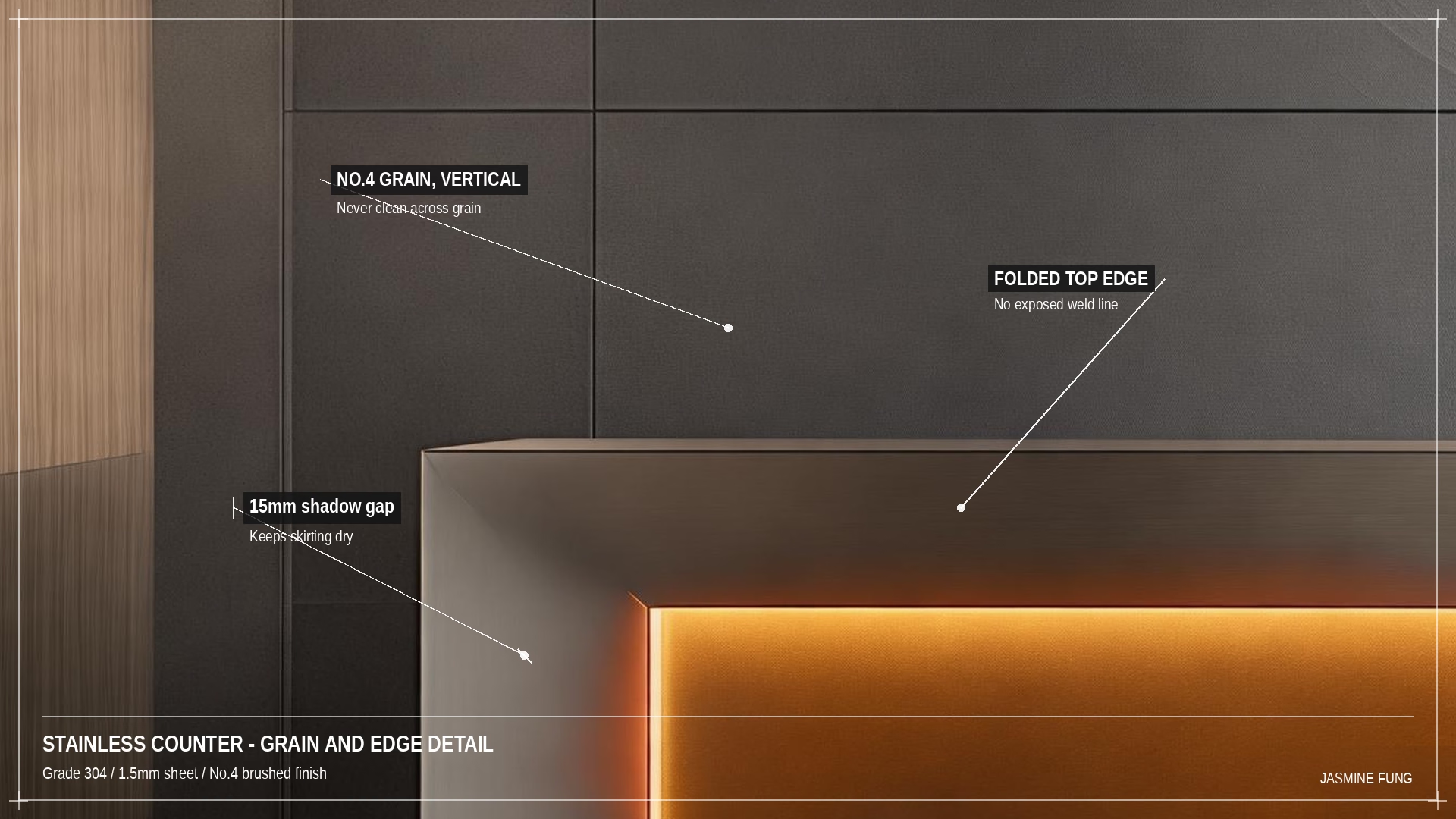
Wear in a shop is concentrated in three places: the counter top where bags and keys land, the front panel where trolleys and pushchairs strike, and the toe area where cleaning machines pass. Solid surface handles the first well and the second poorly – a heavy trolley strike can chip an edge, and although a fabricator can fill and re-sand it, the repair is only invisible if the colour is a solid tone rather than a veined or speckled pattern.
Brushed stainless handles impact better but shows every dent, because a metal skin has no memory. Its advantage is that a scuff blends into the grain rather than reading as damage. For counters at a mall loading route or beside a stockroom door, I specify stainless for the front panel and solid surface for the top – a hybrid that costs about 15% more than all-solid-surface but avoids the two failure modes clients complain about.
- Top surface, heavy bag traffic: solid surface, matte finish, light or mid tone.
- Front panel on a trolley route: brushed stainless in vertical grain.
- Curved or serpentine counter: solid surface only, thermoformed in one piece.
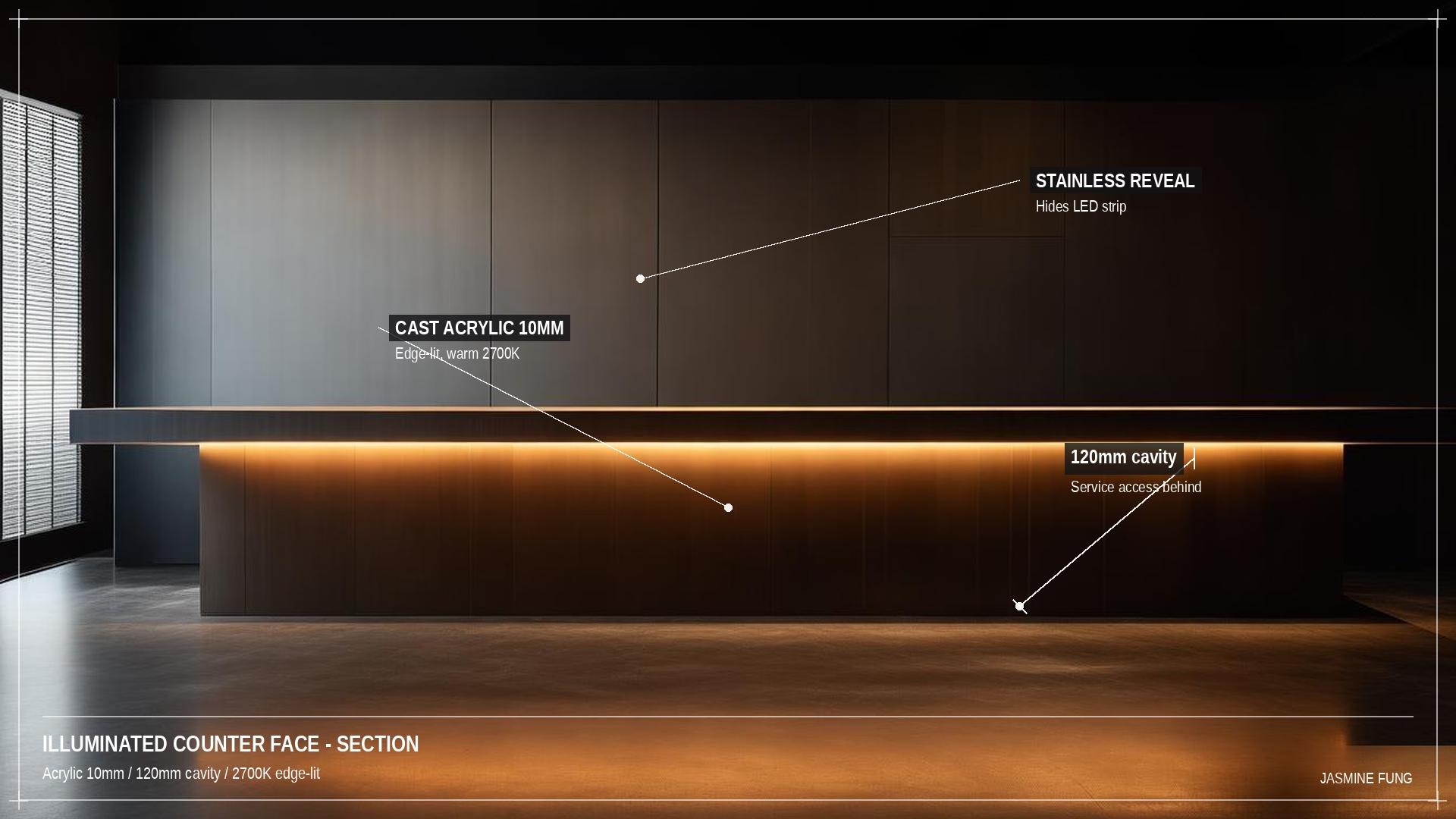
- Illuminated counter face: cast acrylic over an LED cavity, never solid surface.
Dark solid surface shows fingerprints and fine scratches within days of opening; on a high-traffic counter, specify the mid-tone range even when the brand guideline asks for black.
Maintenance cycles that clients will actually run
Every material has a maintenance interval, and the honest question at specification stage is not what the manufacturer recommends but what the mall’s cleaning contractor will do at 7am with a microfiber cloth. A counter that needs a specialist abrasive pad every month will receive it for the first quarter and never again.
Solid surface needs a damp cloth daily and a light abrasive refresh every 12 to 18 months on high-touch areas; a matte finish hides this far better than a gloss one. Brushed stainless needs a damp cloth along the grain daily and a stainless polish monthly to keep finger marks down – and it must never see chloride-based cleaner, which pits the surface and starts a corrosion point that no polish will remove. Cast acrylic needs only a non-ammonia cleaner, but any scratch is permanent.
| Material | Daily | Monthly | Annual refresh | Never use |
|---|---|---|---|---|
| Solid surface | Damp cloth | Mild detergent | Abrasive re-sand on high-touch zones | Scouring powder, acetone |
| Brushed stainless | Damp cloth along grain | Stainless polish | Re-grain if scuffed | Chloride or bleach cleaner |
| Cast acrylic | Damp cloth, non-ammonia | Anti-static wipe | Replace damaged panel | Alcohol solvents, dry wiping |
The sample approval sequence
Most counter failures I have been called to inspect were approved from a 100mm swatch held under showroom lighting. A swatch tells you the colour; it does not tell you the sheen at 45 degrees, how the material reads under the mall’s 3000K downlights, or whether an edge radius will collect dust.
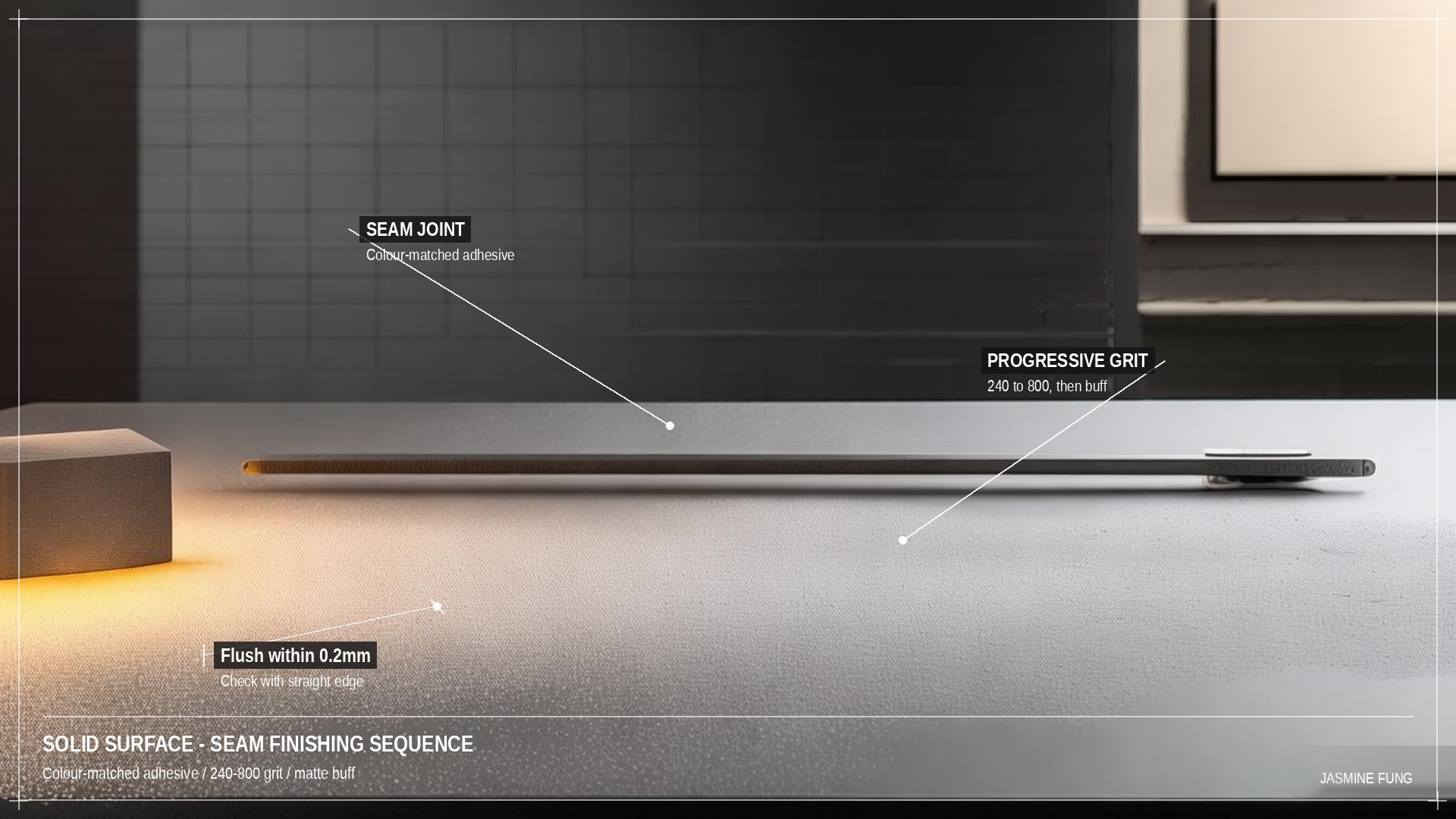
Run approval in three steps. First, a full-size sample: at least 300mm by 300mm in the actual finish, viewed on site under the real lighting. Second, an edge sample at the specified radius, thermoformed rather than machined, because a machined radius and a formed one look different at the corner. Third, a signed finishes schedule with brand, colour code, sheen level, thickness, substrate and cleaning agent written out – the document the cleaner will never read but the contractor will be held to.
- Week 1: issue finishes schedule and request full-size samples from two fabricators.
- Week 2: review samples on site under final lighting, at eye height and at counter height.
- Week 3: approve edge radius and seam position on a mock-up, signed by client and contractor.
- Week 4: release to fabrication with the signed schedule attached to the purchase order.
What to put in the specification
A counter specification that survives tender needs seven lines: material and brand, colour code, thickness, finish sheen, edge detail with radius, substrate and fixing method, and the approved cleaning agent. Add the seam locations as a drawing, not a note, because seam position is the single detail most often changed on site without approval.
For a Hong Kong tenancy, add two more: the fire rating of any substrate and the formaldehyde class of the carcass board, since mall design submissions ask for both and retrofitting them after fabrication is expensive. If the counter contains an illuminated acrylic face, specify the LED cavity depth and a service access panel; a sealed light box with no access is a maintenance problem from day one.
Key takeaways
- Cost: solid surface runs HK$900-1,600 per linear metre, brushed stainless HK$1,400-2,400.
- Lead time: 3-4 weeks for solid surface, 6-8 weeks for a welded stainless counter.
- Repair: solid surface can be sanded back in place; a dented stainless panel cannot.
- Hybrid: stainless front panel with a solid surface top costs about 15% more and removes both failure modes.
- Approval: full-size sample on site, formed edge sample, then a signed finishes schedule.
Further reading
- luxury retail interior design brief for Hong Kong fit-outs
- the 12-week luxury retail fit-out programme
- jewellery display case lighting specification
- effective jewellery counter displays
- modular window display systems
Is solid surface the same as acrylic?
No. Solid surface is a sheet made mostly of aluminium trihydrate mineral filler bound in acrylic or polyester resin, pigmented through its full thickness. Cast acrylic is a clear or coloured plastic sheet used for illuminated panels and risers. They look similar in a swatch book but behave differently under load and repair.
How much does a retail counter cost in Hong Kong?
For a 600mm deep, 950mm high counter including carcass and installation, budget HK$900-1,600 per linear metre for 12mm solid surface, HK$1,100-1,900 for cast acrylic on a frame, and HK$1,400-2,400 for brushed stainless steel. Electrical work and feature cladding are extra.
Can scratches be removed from a solid surface counter?
Yes, in most cases. A fabricator sands the area with progressive grits from 240 to 800 and buffs back to the original sheen. The repair is invisible on solid-tone colours and noticeable on heavily veined or speckled patterns, which is why pattern choice matters before fabrication.
Why does brushed stainless steel sometimes rust in a shop?
Almost always chloride exposure. Bleach-based or chloride floor cleaners left on the surface attack the passive layer on grade 304 steel and start pitting. Rinse with clean water after cleaning, dry the surface, and specify grade 316 if the counter sits near a mall entrance with coastal air.
How long before a counter can be used after installation?
Solid surface joints are sanded and ready the same day. Stainless counters are usable immediately once protective film is removed. Allow 24 hours if any silicone or adhesive is used at the wall junction, so the seal cures without being disturbed by cleaning.